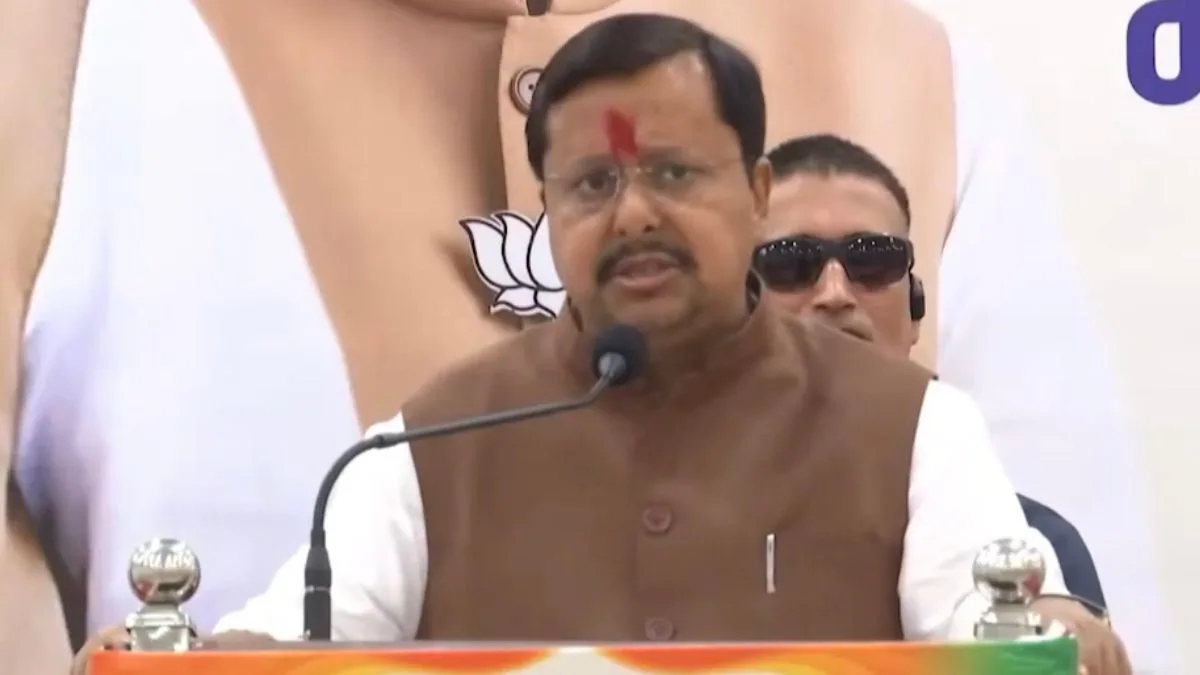
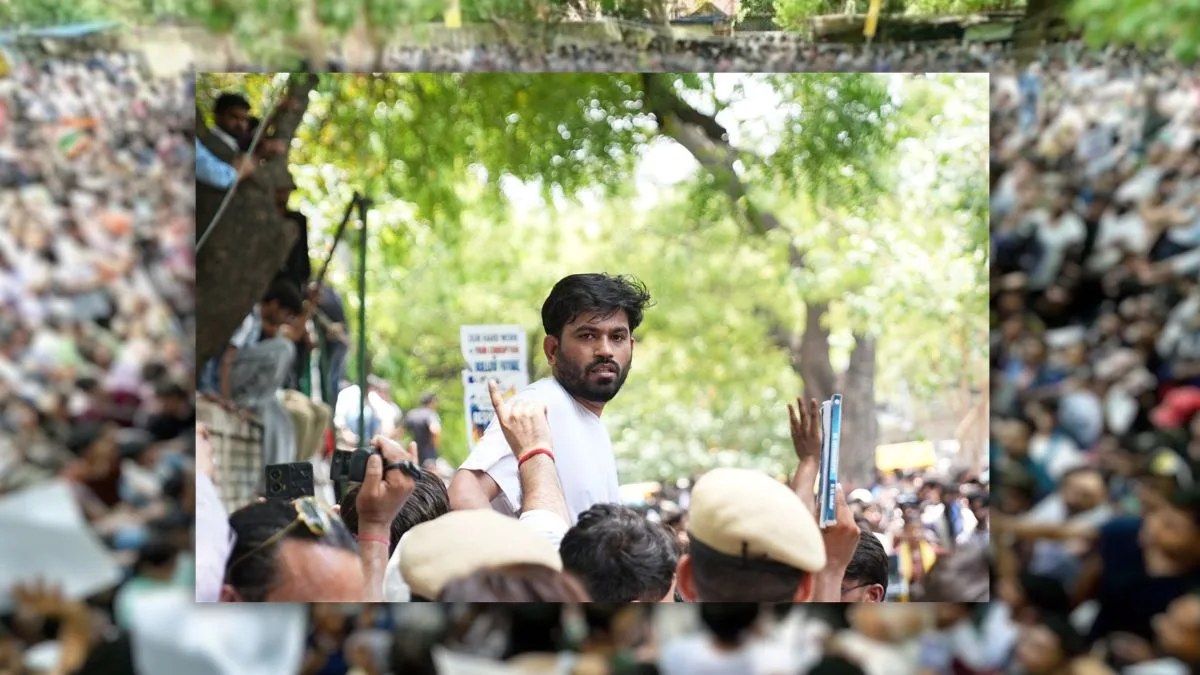
‘Some members being brainwashed’: Tamil Nadu BJP chief alleges bid to fuel resignations after Annamalai exit
Nainar Nagendran categorically asserted that no party member has been authorised to resign and urged cadres to ignore such attempts.
They came from opposite worlds. One memorised scripts. The other memorised the IPC. Now one runs Tamil Nadu and the other is starting from zero, by choice. The last time this state saw that combination, it took fifty years to settle.




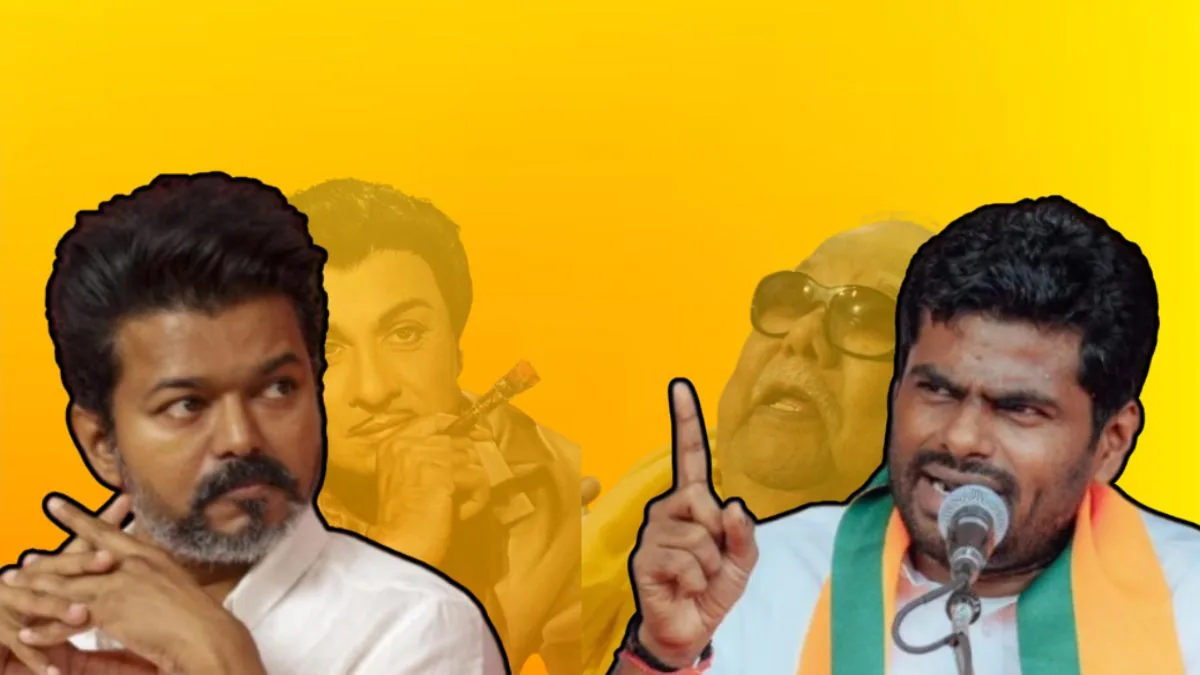
File Photo
Tamil Nadu has always been a state where politics and popular culture refuse to stay separate. The rivalry between MG Ramachandran (MGR) and M Karunanidhi defined five decades of the state’s political life. The two men occupied opposite poles, built fierce loyalties, and turned electoral contests into near-religious events. Something similar is now taking shape between K Annamalai and actor-politician Vijay, though neither man has been around long enough to claim that mantle without qualification.
Kuppusamy Annamalai was born on June 4, 1984, in Thottampatti village in Karur district. He belongs to the Kongu Vellalar Gounder community, a land-owning caste with significant political weight in western Tamil Nadu. He cleared UPSC exam, joined IPS, served in Karnataka police force building reputation in districts like Udupi, Chikmagalur, Bengaluru. Then he earned the nickname “Singham” for his aggressive policing style. He quit the IPS in 2019, returned to Tamil Nadu, and after Rajinikanth’s political plans collapsed, joined the BJP in 2020. Within 11 months of joining, he was made Tamil Nadu BJP president in July 2021, a meteoric rise by any standard.
Advertisement
Vijay, born C. Joseph Vijay in 1974, spent three decades building one of the largest fan bases in Tamil cinema. His fan club, Vijay Makkal Iyakkam, functioned like a proto-political organisation years before he formally entered politics. In February 2024, he launched Tamilaga Vettri Kazhagam (TVK), declaring that Tamil Nadu was “yearning for a fundamental political change.” He named the DMK as his political enemy and the BJP as his ideological enemy, ruling out alliances with either.
Advertisement
Annamalai ran his “En Mann, En Makkal” yatra across all 234 assembly constituencies in Tamil Nadu. He built booth-level committees, trained cadres, and raised the BJP’s visibility in a state where the party had scored just 5.75% of the vote in the 2022 civic body elections. He pushed for the BJP to contest independently rather than depend on the Dravidian majors. And, he was also appointed co-in-charge for the 2023 Karnataka assembly elections, showing Delhi’s initial confidence in him.
Vijay took different route. He launched state-wide tour from September to December 2025 drawing crowds across districts. His second state conference in Madurai in August 2025 showed large and energised party organisation. He hired political strategist Prashant Kishor as a special advisor. He enrolled members through the “Now TVK” app. Internal surveys before the 2026 election put TVK’s support at no less than 15%, with the number higher in several regions.
The 2026 Tamil Nadu assembly election settled one half of this contest decisively. TVK contested alone in 233 constituencies. It won 108 seats, becoming the single largest party. Vijay staked his claim to form the government, brought Congress, IUML, VCK, and other SPA parties on board, and was sworn in as Chief Minister on May 10, 2026. He passed the floor test on May 13.
The 2024 Lok Sabha election was Annamalai’s first real electoral test. He contested from Coimbatore, a Gounder-dominated seat he expected to perform well in. He lost. The BJP, which had aimed for double-digit vote share and at least two Lok Sabha wins, fell short on both counts.
Things deteriorated internally after that. Annamalai had repeatedly clashed with AIADMK’s Edappadi Palaniswami over comments on former Chief Minister J. Jayalalithaa. He had publicly opposed the BJP-AIADMK alliance being rebuilt. Despite his objections, the alliance went through. He resigned as Tamil Nadu BJP president in April 2025 to facilitate it. After that, he was kept away from candidate selection, alliance negotiations, election strategy. In February 2026, he stepped down as election in-charge for six constituencies, citing his father’s ill health.
The 2026 election results confirmed his worst fears. The BJP’s strength in the Tamil Nadu assembly dropped from four MLAs to just one. On June 5, 2026, Annamalai resigned from the BJP’s primary membership. BJP National President Nitin Nabin formally accepted the resignation. Annamalai said he had informed the party of his intention to leave on December 4, 2025, more than six months earlier. He launched “We the Leaders,” describing it as a people’s movement that would eventually become a political party targeting the 2031 assembly elections. Over one million people registered on the platform within days of its launch.
The comparison to MGR and Karunanidhi is useful but needs to be qualified carefully.
MGR and Karunanidhi were both products of the same Dravidian movement, shaped by the same ideological tradition, and personally close before they turned rivals. MGR broke from the DMK in 1972 and launched the AIADMK after years of internal tension with Karunanidhi. Their rivalry then became the central axis of Tamil Nadu politics for fifteen years, until MGR’s death in 1987. Karunanidhi was the writer, the wordsmith, the ideologue. MGR was the performer, the mass symbol, the man with the fan base that converted directly into votes.
The structural parallels with Vijay and Annamalai are visible. Vijay is the film icon who entered politics with a massive pre-existing emotional following, invoking the names of Periyar, Ambedkar, Kamaraj, and Annadurai. He is building what journalists have called “Neo-Dravidian Vijayism.” Annamalai is the outsider who built his politics on governance, data, discipline, and anti-corruption messaging without any cinematic identity. One draws crowds through charisma and cultural memory. The other draws support through speeches, yatras, and organisational cadre work.
Former AIADMK minister KA Sengottaiyan, who joined TVK, drew the comparison directly. He pointed out that when MGR launched the AIADMK, critics said it would “become a flop like a film lasting only 100 days.” MGR proved them wrong. Sengottaiyan said Vijay’s journey had started the same way.
But there are clear limits to the analogy. MGR and Karunanidhi were contemporaries who operated within the same ideological family. Vijay and Annamalai come from entirely different political traditions, different caste backgrounds, different relationships with the idea of Tamil identity. Vijay has positioned himself within the Dravidian social justice tradition. Annamalai, shedding the BJP’s Hindutva label, is now positioning “We the Leaders” around Tamil sub-nationalism and governance reform, trying to attract youth, professionals, and first-time political entrants.
The contest between them matters because of who is absent. The AIADMK, which ruled Tamil Nadu from 1977 to 1989 and alternated power with the DMK for decades after that, is a diminished force. Its reduced presence in the 2026 assembly means the opposition space is genuinely open. Udhayanidhi Stalin, son of M K Stalin, leads the Opposition in the current assembly, which means the DMK is positioning its next generation simultaneously. The political field is more fragmented than it has been in fifty years.
Annamalai has argued, and the 2026 results arguably support, that Tamil Nadu voters were looking for a genuine alternative to the Dravidian duopoly. Vijay found that opening and stepped through it. Annamalai believes the same opening still exists, that Vijay’s victory was built on star power and anti-incumbency against the DMK, and that governance-focused politics has room to grow independently.
Political analysts point out that “We the Leaders” is targeting 2031, which gives Annamalai five years to build an organisation without the immediate pressure of an election. Vijay now has the reverse problem: governing Tamil Nadu with a coalition while managing a party that has never held office before.
The MGR-Karunanidhi rivalry lasted as long as it did partly because both men needed each other. The AIADMK needed the DMK as its ideological foil. The DMK needed the AIADMK to maintain mobilisation. That competitive logic kept both parties alive.
Vijay and Annamalai may be moving toward a similar dynamic. Vijay, as Chief Minister, needs a credible opposition that is neither the old DMK nor a weakened AIADMK. A strong, governance-focused challenger from outside the Dravidian tradition gives TVK a sharper identity. Annamalai, building from scratch with no electoral wins to his name, needs a clearly defined opponent to organise against. The sitting government is the obvious target.
The difference from the original rivalry is that Karunanidhi was a five-time Chief Minister when MGR broke away. Vijay is a first-time chief minister with a coalition government and no precedent to lean on. Annamalai has never won a seat in his political career, having lost both in 2021 and 2024. The stakes are real, but neither man has fully established what they will mean in Tamil Nadu’s long political story.
That story is still being written.
Advertisement